
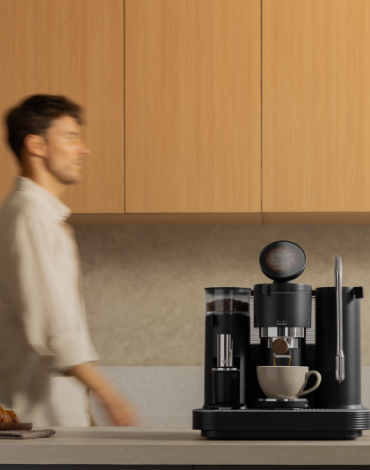
Most espresso stories start with a machine. This one starts with a kitchen counter that had run out of room. A grinder here, a separate scale there, a tamper balanced on a towel, a milk jug waiting for its turn, and a brewer that needed its own corner. Each piece worked, but together they made a small ritual feel like a project. The person making coffee spent as much time moving things around as actually brewing, and the first cup of the day often arrived after a string of small compromises.
That clutter is the problem an integrated system tries to solve. It is not about adding a gadget for its own sake. It is about asking whether the separate steps of espresso — grinding, dosing, tamping, brewing, and weighing — really need to live in separate boxes, or whether they work better when they are designed to talk to each other. When the grinder knows the dose, the brewer knows the target weight, and the scale can stop the shot at the right moment, the drinker stops managing equipment and starts paying attention to taste.
From Separate Tools to One Workflow
In a traditional home setup, every tool has its own logic. The grinder is set by feel. The scale is started by hand. The machine is stopped by watching a timer or a cup. A small error at any stage carries into the next one, and the person at the counter has to catch it. That is why two mornings can taste so different even when the same beans are used. The recipe exists mostly in the drinker’s head, and it is easy to lose.
An integrated approach changes where the recipe lives. Instead of relying on memory and timing, the system holds the key variables together. Grind size, dose, water temperature, and shot weight are no longer four separate guesses. They become parts of one process, checked against each other as the shot runs. For a beginner, that means fewer mysterious failures. For an experienced drinker, it means a result that can be repeated on a busy weekday, not just on a slow Sunday when there is time to fuss.
Why Integration Is Harder Than It Looks
Putting several functions into one machine sounds simple until you try to do it well. A grinder creates heat and vibration. A brewer needs stable temperature and clean water flow. A scale needs a steady, level surface and freedom from vibration. Put them too close together without careful engineering, and each one can interfere with the others. The challenge is not fitting parts into a box. It is making sure each part still performs as if it were standing alone.
That is why the story behind a system like this is less about a single invention and more about a series of trade-offs. How quiet can the grinder be without losing speed? How compact can the machine be without making cleaning difficult? How much automation helps, and how much gets in the way? Good answers to those questions do not show up in a photograph. They show up at seven in the morning, when the machine is used half awake, in a kitchen that is not a showroom.
What Changes in Daily Life
The clearest benefit of integration is consistency without ceremony. A weekday routine might look like this: beans go in, a recipe is chosen, the cup goes under the spout, and the shot stops itself at the right weight. There is still room to adjust, but adjustment becomes a choice rather than a rescue operation. If a new bag of beans arrives, the grind can be tuned once, and the rest of the process follows.
This also changes who can make good coffee in the household. In many homes, one person becomes the unofficial barista because only they know the quirks of the setup. Everyone else sticks to a simpler drink or avoids the machine altogether. When the workflow is built into the system, a partner, a guest, or a teenager can make a decent espresso without a lesson first. That is not a small change. It turns coffee from one person’s hobby into a shared morning habit.
A System, Not Just a Product
Readers who want the background can start with about Meraki, which explains the company’s direction in its own words. What stands out there is the emphasis on the whole experience rather than a single specification. Grind settings, boiler design, and software are presented as parts of one idea: coffee that is easier to repeat, easier to learn, and easier to enjoy at home.
The same thinking shows up in the smaller parts of the setup. Cups, tampers, milk jugs, and cleaning tools are easy to overlook, yet they affect every shot. A well-chosen set of Meraki espresso accessories is not about collecting extras. It is about removing the next source of friction after the machine itself is sorted — the right jug for steaming, the right tool for distribution, and nothing that has to be hunted down in a drawer.
Who This Approach Suits Best
An integrated system suits people who love good espresso but do not want their mornings to depend on perfect technique. It suits households where more than one person makes coffee, and where time is short. It also suits drinkers who are curious about beans and flavour but tired of troubleshooting equipment before they have even tasted the cup.
It is less suited to someone who enjoys the separate-tool ritual itself, or who wants to swap every component independently. That is a fair preference, and the traditional route remains a good one for those drinkers. The choice is not between serious coffee and easy coffee. It is between two different kinds of enjoyment: the pleasure of mastering a collection of tools, and the pleasure of a great cup that arrives with less friction.
In the end, the story is a simple one. Espresso at home became complicated because each improvement arrived as a separate purchase. Integration asks whether those improvements can be designed together from the start, so the morning feels less like operating a small laboratory and more like making coffee. When that works, the machine fades into the background — and the coffee, finally, gets the attention it deserves.

